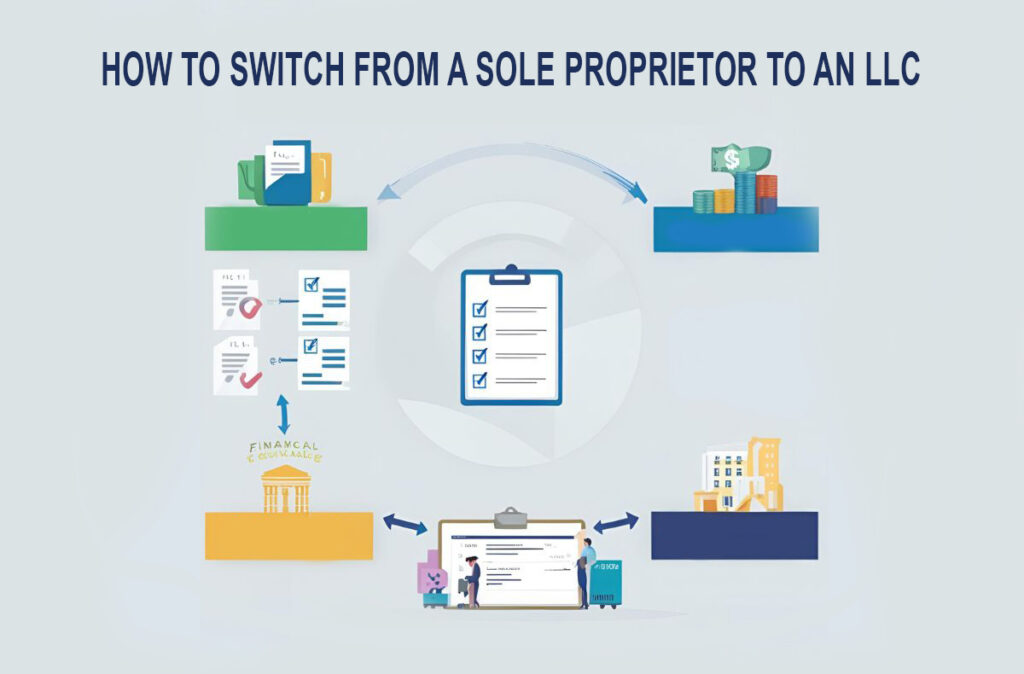
Starting a business as a sole proprietor is one of the most common paths for new entrepreneurs in the United States. It is simple, inexpensive, and requires almost no formal paperwork to get started. But as your business grows, the limitations of operating as a sole proprietor become increasingly difficult to ignore. Personal liability exposure, limited credibility with clients and lenders, and restricted tax planning options are just a few of the challenges that push business owners toward forming a Limited Liability Company.
In 2026, switching from a sole proprietorship to an LLC is one of the smartest moves a growing business owner can make. This guide walks you through every step of the process, explains the key legal and tax differences between the two structures, and helps you understand exactly what to expect along the way.
At TaxMagic, we have helped hundreds of entrepreneurs make this transition smoothly and efficiently. Here is everything you need to know.
Why Switch from Sole Proprietor to LLC?
Before diving into the steps, it is worth understanding why this conversion matters so much.
As a sole proprietor, there is no legal separation between you and your business. This means that if your business is sued, a client files a claim against you, or a vendor takes you to court, your personal assets are fully exposed. Your home, your savings, your vehicle, and everything else you own can be used to satisfy a business debt or judgment.
An LLC creates a legal wall between you and your business. This protection is called limited liability, and it is the single most important reason most sole proprietors eventually make the switch.
Beyond liability protection, an LLC offers significant advantages in terms of credibility, financing access, and tax flexibility. Banks are more willing to extend credit to an LLC. Larger clients and government contracts often require vendors to operate as a formal business entity. And the IRS allows LLCs to choose from multiple tax treatment options that can dramatically reduce what you owe each year.
According to the U.S. Small Business Administration, an LLC is one of the most popular business structures for small business owners because it combines the liability protection of a corporation with the simplicity and tax flexibility of a partnership or sole proprietorship.
LLC vs Sole Proprietorship: Key Differences in 2026
Understanding the core differences between these two structures helps you make an informed decision and sets realistic expectations for what changes after you convert.
Personal liability: A sole proprietor bears unlimited personal liability for all business debts and legal claims. An LLC member is generally protected from personal liability beyond their investment in the company.
Taxation: Both structures default to pass-through taxation, meaning business profits flow through to your personal tax return. However, an LLC has the option to elect S-Corp tax treatment, which can reduce self-employment taxes significantly for owners who pay themselves a reasonable salary.
Credibility: Operating as an LLC signals to clients, vendors, and lenders that your business is an established, formal entity. Many larger organizations will only work with registered business entities rather than individual sole proprietors.
Ongoing requirements: A sole proprietorship has almost no ongoing administrative requirements. An LLC requires state-level compliance, including annual reports, registered agent maintenance, and, in some cases, annual fees. These are manageable but worth budgeting for.
Cost: Forming an LLC involves a one-time state filing fee that typically ranges from $50 in states like Kentucky and Arkansas to $500 or more in states like Massachusetts. Most states fall in the $100 to $200 range.

Step 1: Choose and Verify Your LLC Name
The first step in converting from a sole proprietorship to an LLC is selecting a name for your new business entity. Your LLC name must be unique within your state and must include a designator such as LLC, L.L.C., or Limited Liability Company.
Most states allow you to search existing business names through an online database on the Secretary of State website. Before you settle on a name, also check whether the corresponding domain name and social media handles are available, since brand consistency matters for your online presence.
If you want to reserve your chosen name while you complete the rest of the formation process, most states allow you to file a name reservation for a small fee, typically between $10 and $50.
TaxMagic helps clients research and verify name availability across all 50 states so the formation process moves forward without delays.
Step 2: Appoint a Registered Agent
Every LLC in the United States is required to designate a registered agent. A registered agent is a person or company that agrees to receive official legal and government correspondence on behalf of your LLC, including service of process if your business is ever sued.
Your registered agent must have a physical street address in the state where your LLC is formed and must be available during normal business hours. You can serve as your own registered agent, designate a trusted individual, or hire a professional registered agent service.
Many business owners choose a professional registered agent service to protect their privacy, since the registered agent’s address becomes part of the public record. These services typically cost between $50 and $300 per year depending on the provider.
Step 3: File Articles of Organization
The Articles of Organization are the formal document that officially creates your LLC with your state. This document is filed with the Secretary of State or equivalent state agency and typically requires the following information: your LLC name, your principal business address, the name and address of your registered agent, the names of the LLC members or managers, and, in some states, the purpose of your business.
Filing fees vary by state. Most states process Articles of Organization within one to three weeks, though many offer expedited processing for an additional fee if you need your LLC formed faster.
The IRS provides guidance on how LLC formation affects your federal tax obligations, and it is important to understand those implications before you file.
TaxMagic handles the entire Articles of Organization filing process for our clients, ensuring accuracy and completeness so there are no rejections or delays.
Step 4: Create an LLC Operating Agreement
One of the most commonly overlooked steps in LLC formation is drafting an Operating Agreement. An Operating Agreement is an internal document that outlines how your LLC will be governed, how profits and losses will be distributed, what happens if a member wants to leave, and how major business decisions will be made.
Even if you are forming a single-member LLC, meaning you are the only owner, an Operating Agreement is strongly recommended and required by law in several states, including California, New York, Missouri, Maine, and Delaware.
A well-drafted Operating Agreement protects your limited liability status by demonstrating that your LLC is a legitimate, separately operated business entity. Without one, courts may sometimes disregard the LLC structure and hold owners personally liable, a situation known as piercing the corporate veil.
TaxMagic helps clients draft customized Operating Agreements that reflect their specific business structure, ownership arrangement, and long-term goals.
Step 5: Apply for a New EIN from the IRS
Even if you already have an Employer Identification Number as a sole proprietor, forming an LLC requires you to apply for a new EIN. This is because your LLC is a legally separate entity from you as an individual, and it needs its own federal tax identification number.
Your EIN is used for everything from opening a business bank account to filing payroll taxes to submitting your annual federal tax return. The good news is that applying for an EIN is completely free through the IRS EIN online application, and you can receive your number instantly if you apply online.
TaxMagic helps clients complete the EIN application correctly and coordinates the new EIN with all relevant tax filings so there is no confusion between your old sole proprietor records and your new LLC records.
Step 6: Open a Business Bank Account for Your LLC
One of the most important financial steps after forming your LLC is opening a dedicated business bank account in the name of the LLC. Mixing personal and business finances is one of the most common mistakes new LLC owners make, and it creates serious problems in two areas.
First, it makes your bookkeeping significantly more complicated and increases the risk of errors on your tax return. Second, commingling funds can jeopardize your limited liability protection. If a court finds that you routinely used business accounts for personal expenses or vice versa, it may rule that your LLC was not operated as a legitimate separate entity and hold you personally liable for business debts.
A dedicated LLC bank account keeps your finances clean, makes tax preparation easier, and reinforces the legal separation between you and your business.
Step 7: Update Business Licenses, Permits, and Contracts
Once your LLC is formed, you need to transfer or update all existing business licenses and permits to reflect your new entity name and structure. This process varies by industry and location, so check with your city, county, and state licensing agencies to understand exactly what needs to be updated.
You should also review all existing contracts with clients, vendors, and service providers. Going forward, contracts should be signed in the name of the LLC rather than your personal name. Update your invoices, proposals, website, email signatures, and any other business materials to reflect the new LLC name and entity type.
Notify your clients and key business partners of the change so they can update their records as well. This step also reinforces your professional image and signals that your business is growing and formalizing.
Step 8: Choose Your LLC Tax Structure
One of the most financially significant decisions you will make as a new LLC owner is choosing how your business will be taxed. The IRS offers several options, and selecting the right one can save you thousands of dollars every year.
By default, a single-member LLC is taxed as a sole proprietorship, meaning all profits are reported on your personal tax return via Schedule C and are subject to self-employment tax of 15.3 percent on the first dollar of net income.
A multi-member LLC is taxed as a partnership by default, with each member reporting their share of profits on their individual returns.
However, LLCs also have the option to elect S-Corporation tax treatment by filing IRS Form 2553. Under an S-Corp election, you pay yourself a reasonable salary as an employee of your LLC, and only that salary is subject to self-employment taxes. Any additional profits above your salary are distributed as owner distributions and are not subject to self-employment tax.
For LLC owners generating consistent net profits above approximately $40,000 to $50,000 per year, the S-Corp election can produce meaningful tax savings. According to the IRS S-Corporation guidance, this election must be made no later than two months and fifteen days after the beginning of the tax year in which it is to take effect.
TaxMagic analyzes each client’s specific income level and business structure to determine whether an S-Corp election makes financial sense and handles the filing if it does.
How Long Does It Take to Form an LLC in 2026?

Processing times vary significantly by state. In most states, standard processing takes one to three weeks from the date your Articles of Organization are filed. States like Delaware, Wyoming, and Nevada are known for faster processing, often completing formation within a few business days.
Many states offer expedited processing for an additional fee ranging from $25 to $200, which can reduce processing time to as little as one business day in some cases.
TaxMagic coordinates the timing of your LLC formation with your transition plan so there is minimal disruption to your existing business operations during the switch.
Ongoing LLC Compliance Requirements
Forming your LLC is not a one-time task. Maintaining your LLC in good standing requires ongoing compliance with state requirements. Most states require LLCs to file an annual report and pay an annual fee to remain active. Failure to file on time can result in late penalties or administrative dissolution of your LLC.
Some states also require LLCs to publish a notice of formation in a local newspaper, particularly in New York and Arizona. This requirement adds cost and time to the formation process in those states.
TaxMagic tracks annual filing deadlines and compliance requirements for all client LLCs so you never miss a deadline or face unnecessary penalties.
Final Thoughts
Switching from a sole proprietorship to an LLC in 2026 is one of the most important steps you can take to protect your personal assets, reduce your tax liability, and position your business for long-term growth. The process is straightforward when you understand each step, but the legal and tax decisions involved have real consequences that are worth getting right from the beginning.
From choosing your LLC name and filing your Articles of Organization to drafting your Operating Agreement and evaluating your tax structure, TaxMagic is with you at every stage. Our team of credentialed professionals handles the paperwork, advises on the right tax elections, and sets your new LLC up for success from day one.
Contact TaxMagic today and let us help you make the switch the right way.

